Showing posts with label UNESCO World Heritage. Show all posts

Sunday, January 21, 2018

Jordan - UNESCO Postcard - Um Er-Rasas

A magnificent postcard posted direct from Jordan featuring a UNESCO World Heritage Site - Um Er-Rasas. It is one of the 5 UNESCO sites from Jordan.
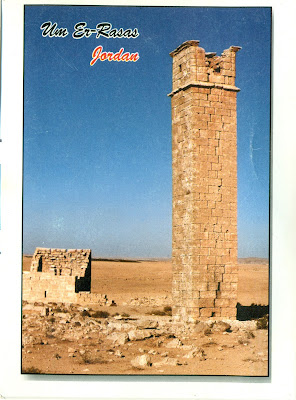
 Most of this archaeological site, which started as a Roman military camp and grew to become a town from the 5th century, has not been excavated. It contains remains from the Roman, Byzantine and Early Muslim periods (end of 3rd to 9th centuries AD) and a fortified Roman military camp. The site also has 16 churches, some with well-preserved mosaic floors. Particularly noteworthy is the mosaic floor of the Church of Saint Stephen with its representation of towns in the region. Two square towers are probably the only remains of the practice, well known in this part of the world, of the stylites (ascetic monks who spent time in isolation atop a column or tower). Um er-Rasas is surrounded by, and dotted with, remains of ancient agricultural cultivation in an arid area.
The two stamps used for postage include:-

  • Right side stamp in the photo shows the Ruins of Arc de Triomphe. Initially the stamp was issued in 2003 for a value of 25 Fils, however it was later surcharged for 80 pt in 2009.
  • The fox stamp on the left is with a face value of 30 pt was issued on 25th August 2009. It was one of the set of 5 stamps.


Wednesday, November 29, 2017

Upper Svaneti, Georgia - A UNESCO World Heritage Site

A UNESCO World Heritage Site postcard from Georgia for my UNESCO Collection - Upper Svaneti.
Preserved by its long isolation, the Upper Svaneti region of the Caucasus is an exceptional example of mountain scenery with medieval-type villages and tower-houses. The village of Chazhashi still has more than 200 of these very unusual houses, which were used both as dwellings and as defence posts against the invaders who plagued the region.
The property occupies the upper reaches of the lnguri River Basin between the Caucasus and Svaneti ranges. It consists of several small villages forming a community that are dominated by the towers and situated on the mountain slopes, with a natural environment of gorges and alpine valleys and a backdrop of snow-covered mountains. The most notable feature of the settlements is the abundance of towers.
The beautiful stamp used on the back of the postcard was part of the set "Cultural Heritage of Georgia". The complete set was issued in a souvenir sheet of 4 stamps. The stamp shows "Golden Necklace, II-III Century AD". The stamp is of 2.0 Georgian Lari (GEL).
The postcard has been postmarked from Telavi, Georgia.

Sunday, November 19, 2017

My Favourite Postcard - Pakistan Flag Card from United Nations Headquarters in New York

Today I am sharing one of my favourite and most-beloved postcards from my collection.
The postcard shows the National Flag of "Pakistan" - The Most Beautiful Country in the World!

The country name is written twice on the front bottom of the card ... with the United Nations emblem in the centre.
In fact the postcard has been bought from the United Nations Headquarters Souvenir Shop in New York by a very dear friend Nan on my special request.
Three beautiful stamps are pasted at the back for posting ... with the United Nations postmarks on them. The three stamps feature the following UNESCO World Heritage Site Stamps:-

  • Ayutthaya, Thailand - 2015
  • The Great Wall, China - 2013
  • Lednice-Valtice, Czech Republic - 2016

Indeed a beauty to have it in my collection!

May Allah Almighty bless Pakistan with ultimate peace and prosperity! Aameen!

Friday, March 24, 2017

Sri Lanka: Dambulla Cave Temple

Received this beautiful multi-view card from Sri Lanka some time ago. Dambulla Cave Temple is a UNESCO World Heritage Site and is also known as "The Golden Temple of Dambulla"!
 You can see some interesting details about the Dambulla Cave Complex by visiting the link here.

Three gorgeous stamps have been used on the postcard. Sri Lanka has improved it's stamp designs in the last few years a lot. I really like the scouting stamp at the right-most position. It's extremely proportionate and lovely design.
  • The right most stamp was issued in 2016 at the eve of "World and Sri Lanka Cub Scouts Centenary 1916-2016" and was of 10 Sri Lankan Rupees denomination.

  • The stamp in the center is a part of a set of 10 stamps issued on Solar System in 2014 and shows the Sun. Denomination is 7 Sri Lankan Rupees. It was the cheapest stamp in the set.
  • The Greater Flamingos stamp on the left side is a part of 4-stamp set issued by Sri Lanka on World Wetland Day and the birds are shown in Chundikulam National Park.

Tuesday, April 30, 2013

P is for Pakistan Postcards

As a matter of fact, most of you must be knowing that this blog is dedicated to my postcards collection and taking part in ABC Wednesday is really fun especially when I came across the latest post, it was evident that today's post is dedicated to Postcards of my beloved PAKISTAN.
In this post, I shall share 3 of my favorite postcards with you, so that you can enjoy a glimpse of my beautiful Pakistan. To know more about these places, you can either click on the photo or visit the link at the bottom of the post.
K-2 is Pakistan's Highest Mountain and the World's 2nd Highest Mountain after the majestic Mount Everest. Standing tall at 8,611 meters, K-2 is a mighty mountain which is much more difficult to climb than its elder brother, Mount Everest.
As per Wikipedia: "K2 is known as the Savage Mountain due to the difficulty of ascent and the second-highest fatality rate among the eight thousanders. For every four people who have reached the summit, one has died trying. It is more hazardous to reach K2 from the Chinese side; thus, it is mostly climbed from the Pakistani side. Unlike Annapurna, the mountain with the highest fatality-to-summit rate, K2 has never been climbed in winter."


Lahore Fort - One of Pakistan's marvellous pieces of architecture and also a UNESCO World Heritage Site in Danger.
You can read more at one of my previous posts here: Lahore Fort or at Wikipedia here: Lahore Fort at Wikipedia
Takht Bhai (or Takht Bahi) is a Buddhist monastic complex dating to the 1st century BCE. The complex is regarded by archaeologists as being particularly representative of the architecture of Buddhist monastic centers from its era. It was listed as a UNESCO World Heritage Site in 1980.
You can read more about these fascinating ruins at Ruins of Buddhist Monastery at Takht-e-Bahi, Swat Valley  in another post at my UNESCO blog.
Having said that its your turn to share your opinion in the comments section below. I would love to hear your thoughts about this post!!!

Wednesday, March 13, 2013

A Winter Postcard from St. Petersburg in Russia

Recently I received a beautiful postcard from Russia showing a winter scene and a Parland Railing of the "The Church of the Resurrection of the Christ"
St. Petersburg is one of the UNESCO World Heritage Sites from Russia and you can read my detailed post at my UNESCO Postcards Blog here.
Two beautiful stamps showing a castle and a boat have been used by the sender - Katya.
Katya has also written "Happy Postcrossing" in a lovely way, accompanied by a Smiley.
 Thanks a lot Katya for this amazingly beautiful postcard and Happy Postcrossing.
If you have any question/ observation/ suggestion, please leave a comment below.


Tuesday, January 10, 2012

Golden Sand Beach from China - A UNESCO World Heritage Site

Here is a Magnificent Postcard from China depicting one of the views of Huanglong: Scenic and Historic Interest Area. The view depicted on the postcard is of Golden Sand Beach.
It is a UNESCO World Heritage Site from China, and is popular for its colorful views. You can read more at my UNESCO Postcards Blog here.

Sunday, July 24, 2011

Buddhist Monastery and Ruins at Takht-i-Bahi

It is astonishing to know that people from oldest times were more civilized and well-behaved as compared to present times, keeping in mind the technological backwardness and lack of infrastructure. This magnificent piece of architecture of a Buddhist Monastery was discovered in 1st Century and it is quite well-preserved till date.
The complex consists of court of stupas, temple complex, monastical complex and residential cells. All rooms are well-constructed using bricks.
The irony of the time is that, even most of the Pakistanis do not know about this site or have not seen it themselves. A large majority has even not heard about it. It is one of the only 6 UNESCO World Heritage Site from Pakistan included in the UNESCO list.
You can read more on my UNESCO Sites Blog at: "Buddhist Ruins of Takht-i-Bahi and Neighbouring City Remains at Sahr-i-Bahlol"

Saturday, July 23, 2011

Historic Center of Yaroslavl, Russia - A Fairy Tale Land

At first sight, I thought that this fairy tale castle is depicted from Narnia or bears a close resemblance with Hogwarts School of Witchcraft and Wizardry - as mentioned in Harry Potter Books by JK Rowling, but the actual story is slightly different.
The postcard is from the beautiful city of Yaroslavl in Russia, which is a major commercial center in the area since 11th century. The castle shown on the card is absolutely awesome. The clouds and the yellowish trees make the scenery even more charismatic. It is infact a painting, but I believe that the actual scenery would be as beautiful as it is shown here.
You can read more about the Historic Areas of Yaroslavl in Russia on my UNESCO Sites Blog, as it is also a famous UNESCO World Heritage Site in Russia.

Wednesday, February 23, 2011

De-Listed Omani UNESCO World Heritage Site - Arabian Oryx Sanctuary

Today I would like to share another stunning postcard with you. Here I have a UNESCO World Heritage Site from one of its kind Site. I say so because the card depicts views from Arabian Oryx Sanctuary from Oman and the site was de-listed from the UNESCO List in 2007. It is one of the only two sites de-listed from the UNESCO Site List.  The other one was Dresden Elbe Valley in Germany which was de-listed in 2009.
As per Wikipedia, "Oryx is one of four large antelope species of the genus Oryx. Three of the species are native to arid parts of Africa, with a fourth native to the Arabian Peninsula. Their pelage is pale with contrasing dark markings in the face and on the legs, and their long horns are almost straight. The exception is the Scimitar Oryx, which lacks dark markings on the legs, only has faint dark markings on the head, has an ochre neck, and horns that are clearly decurved. 
The Arabian Oryx was only saved from extinction through a captive breeding program, and the Scimitar Oryx, which probably now is extinct in the wild, also relies on a captive breeding program for its survival."
You can read the brief description of "Arabian Oryx Sanctuary" as described on Official UNESCO WHS here.
The stamps used on the postcard are also very beautiful.

  • The $1 postage stamp on the left is a part of a set of 9 postage stamps issued in 2005 by Australian Post as the "Greetings" series.
  • The second stamp on the right is a $1 stamp from the "Wild Flowers" set of 4 stamps issued in 2006. The stamp shows the wild flower - Pincushion Hakea
  • I also liked the Australian Post Airmail Label on the Postcard. Its so graceful and artistically designed.

The Postcard was sent to me by Laurent from Postcard Interactive Company of Sydney. It is a group of very seasoned Postcard Swappers who are also running a small printing company. They specialize in publishing special thematic postcards on world-wide loved themes like UNESCO World Heritage Sites, Airports and Aircrafts, Map cards, Navy Bases, Cruise Ships, Stadiums, Lighthouses, Railways, World Animals and other similar topics. Some of the unique and very gorgeous Limited Edition covers can also be found on the site.
You can buy postcards or covers from Postcard Interactive Company of Sydney at a very economical price or even swap with them.
If you buy from the Company, they will send you the postcards without any extra postage charges - with a minimum order of only 6 postcards. I assure you that the rates of Postcard Interactive Company of Sydney are very competitive and less expensive while the quality is superb. So check them now and find your favorite postcards or covers among hundreds of items on the site.

Friday, February 4, 2011

Historic Views of Istanbul, Turkey

Here is a beautiful UNESCO World Heritage Site postcard from Turkey showing "Historic Areas of Istanbul". It is a magnificent postcard showing Suleymaniyah Mosque built in 16th Century AD.
The stamps are also very nice especially I loved the aircraft stamp.
 Read more about the postcard and the stamps here: "UNESCO WHS Turkey: Historic Areas of Istanbul"

Wednesday, June 16, 2010

UNESCO WHS Postcard from Athens, Greece - Parthenon in Athenian Acropolis

Hi!
I never knew that I had this magnificent UNESCO World Heritage Site in my collection until today. The postcard was sent to me by a lovely phonecard collector from Greece - Makis. Since it came to me with a package of used phonecards therefore it was placed in my phonecards collection portion. It in indeed a magnificent postcard depicting Parthenon in Athens, Greece.
Interestingly, Parthenon has served the purpose of being a treasury, a Christian temple, a Muslim Mosque and an Military Ammunition Dump in the past.

Brief History as per Wikipedia
  • The Parthenon is a temple in the Athenian Acropolis, Greece, dedicated to the Greek goddess Athena, whom the people of Athens considered their protector. 
  • Its construction began in 447 BC and was completed in 438 BC, although decorations of the Parthenon continued until 431 BC
  • It is the most important surviving building of Classical Greece, generally considered to be the culmination of the development of the Doric order
  • Its decorative sculptures are considered some of the high points of Greek art
  • The Parthenon is regarded as an enduring symbol of Ancient Greece and of Athenian democracy and one of the world's greatest cultural monuments. 
  • The Parthenon itself replaced an older temple of Athena, which historians call the Pre-Parthenon or Older Parthenon, that was destroyed in the Persian invasion of 480 BC
  • Like most Greek temples, the Parthenon was used as a treasury
  • For a time, it served as the treasury of the Delian League, which later became the Athenian Empire
  • In the 6th century AD, the Parthenon was converted into a Christian church dedicated to the Virgin Mary
  • After the Ottoman Turk conquest, it was turned into a mosque in the early 1460s, and it had a minaret built in it. 
  • On 26 September 1687, an Ottoman Turk ammunition dump inside the building was ignited by Venetian bombardment. The resulting explosion severely damaged the Parthenon and its sculptures. 
  • In 1806, Thomas Bruce, 7th Earl of Elgin removed some of the surviving sculptures, with Ottoman Turk's permission. These sculptures, now known as the Elgin Marbles or the Parthenon Marbles, were sold in 1816 to the British Museum in London, where they are now displayed. 
  • The Greek government is committed to the return of the sculptures to Greece, so far with no success.
Thanks a lot Makis for such a magnificent postcard.
Do you like the postcard? 
What do you think: Is there any other building which has been used so diversely? 

Sunday, May 2, 2010

Greetings from Malacca - UNESCO World Heritage Site

I love postcards from Malaysia and here is one of my magnificent ones. This cool postcard comes from the historic city of Malacca in Malaysia. The civilization in this region started somewhere in 13th century. Malacca has a lot of signs of Portugese, Dutch and British colonization from the past centuries.
This cultural and historical city centre was listed as a UNESCO World Heritage Site since 7 July 2008.
The stamp featured on the postcard shows a scene from Malaysian cartoons.
This magnificent postcard was sent by Ilyani from Imagica. Thanks a lot pal!!!

Thursday, April 22, 2010

#22: Pakistan; Shalimar Gardens – A UNESCO World Heritage Site (In Danger)

Picture 023
Here is my first UNESCO World Heritage Site postcard from Pakistan. In the UNESCO World Heritage Site List they are mentioned as “Fort and Shalimar Gardens in Lahore”. Since the sites are located right in the middle of the second largest city of Pakistan – Lahore, thus at present, most of the area in the surroundings of the Lahore Fort and the Gardens is covered with civilian population. Even most of the portion of the fort is being used by civilian population. The main parts of the fort including main entrance and the important buildings have been kept in a better condition by the concerned departments. It is still a worth visiting place and a must-see for any foreign or local tourist visiting Lahore City.
Shalimar Garden is located at some distance form the Fort. The gardens are as beautiful as they are shown in the postcard. The gardens were built by the Mughal Emperor Shah Jahan. The construction started in 1641 AD and completed in 1642 AD. The gardens measure 658x258 meters in size. The gardens are laid out in the shape of an oblong paralellogram and is surrounded by a high brick wall.
The garden consists of three terraces which are elevated by 13-15 feet above each other. The three terraces are named in Urdu. Their names and meanings are as follows:-
  • Top-most Terrace is named Farah Bakhsh meaning Bestower of Pleasure
  • Middle Terrace is named Faiz Bakhsh meaning Bestower of Goodness
  • Lowest Terrace is named Hayat Bakhsh meaning Bestower of Life
The garden has a total of 410 fountains and five water cascades including The Great Marble cascade and Sawan Bhadoon.
The site was included in the UNESCO World Heritage Site List in 1981. In 2000, the site was included in the Endangered UNESCO Sites List. I shall soon be sharing a postcard featuring Lahore Fort as well.

Monday, June 1, 2009

Postcard #16: Buddha Statue in Afghanistan's Bamiyan Valley


Hello!
A beautiful postcard from Afghanistan which is rich with cultural heritage and is definitely a history lesson. The Afghanistani postcard features one of the beautiful UNESCO World Heritage Sites of the country - "Cultural Landscape and Archaeological Remains of Bamiyan Valley". The postcard shhows the landscape of Bamiyan Village with a huge Buddha statue of Bamiyan Valley in the background.

There are two statues in Bamiyan Valley which were built during 6th century. The statues represent a classic blended style of Indo-Greek art. The two giant statues, named Vairocana and Sakyamuni, measure 55 and 37 metres high respectively and are the largest examples of standing Buddha carvings in the world.

The Buddha statues of Bamiyan Valley gained World fame when Taliban Government in Afghanistan destroyed the Buddhas using demolitions and tank barrages. The re-construction of the Buddhas is on the cards but nothing has been done so far. After the destruction of Buddha statues, 50 caves were also revealed. 12 of these caves wall oil-paintings have been discovered. Japanese experts believe that these oil-paintings were painted between 5th and 8th century.

In Sep 2008, another statue of 19-metre-long "Sleeping Buddha" has been found nearby. It depicts the pose known to Buddhists as the scene where Buddha passed into Nirvana.

Thursday, May 28, 2009

Postcard #15: City View of Istanbul, Turkey


A beautiful postcard from Turkey featuring a city view of the magnificent city - Istanbul. Istanbul is the largest city of Turkey with a population of over 12.6 million. It is located in the Bosphorus Strait and encompasses the natural harbour known as the Golden Horn. It is the only metropolis in the World which is located in two continents - Asia and Europe. The "Historic Areas of Istanbul" were added to the UNESCO World Heritage Sites List in 1985.

This real-posted postcard features Galata Bridge, New Mosque and Sulemaniye

The Galata Bridge.   The bridge shown on the postcard was called as Fourth Galalta Bridge.  It was built in 1912 AD by a German firm MAN AG for 350,000 gold liras. This floating bridge was 466 m long and 25 m wide. The fourth Galata Bridge was damaged badly in a fire in 1992 AD. The Galata Bridge spans the Golden Horn

Galata Bridge of today,  which is called Fifth Galata Bridge,  is a bascule bridge and it was constructed in 1994. It is 490 m long with a span of 80 m. The deck of the bridge is 42 m wide and has 3 vehicular lanes and one walkway in each direction.


The New Mosque.   The New Mosque can be seen in the top left corner of the postcard. The New Mosque or Mosque of the Valide Sultan is an Ottoman imperial mosque located on the Golden Horn at the southern end of Galata Bridge. The construction of the mosque started in 1597 AD but the construction was stopped due to various problems. The partially constructed structure of the Mosque was destroyed by a fire in 1660 AD and fell into ruins. The reconstruction started and the mosque was completed in 1663AD and inaugurated in 1665 AD. It is one of the best-known sights of Istanbul.

Suleymaniye Mosque.   The Suleymaniye Mosque (at the top-right corner of postcard) is also an Ottoman imperial mosque in Istanbul. It is the second largest mosque in the city. It was built on the order of Sultan Suleiman I (Suleiman the Magnificent). The construuction on the mosque started in 1550 AD and ended in 1557 AD.
 
Suleymaniye was later destroyed by a fire in 1660 AD (probably the same fire in which New Mosque was destroyed) and was restored later. In 1766 AD, a part of dome was destroyed due to an earth quake. Many repairs had overcome the initial decoration of the mosque. Even the colour scheme of the dome and various other parts was changed. The mosque was restored again in the middle of the 19th century.

During World War I, the courtyard was used as a weapons/ammunition depot and mosque suffered another huge fire when some of the ammunition got ignited. It was fully restored in 1956 AD. Suleymaniye is also one of the areas considered to be the part of "Historical Areas of Istanbul" which is one of the UNESCO World Heritage Sites.

 
The postmark shows that the postcard was sent on 21 October 1991 from Turkey. The stamps used on the postcard were issued in 1985 as a definitive series. However there are some over-prints on the stamps. Can some one give any information about these over-prints???

Tuesday, April 28, 2009

Postcard #14: Pakistan: King Priest from Moenjodaro - A UNESCO World Heritage Site in Pakistan


A beautiful postcard from Pakistan featuring the "King Priest" found from the ancient ruins of Moenjodaro in Sindh, Pakistan.

Seated male sculpture is called as "Priest King" (even though there is no evidence that either priests or kings ruled the city). This 17.5 cm tall statue is one of the most beautiful artifacts, which has become a symbol for the Indus valley civilization. Archaeologists discovered the sculpture in Lower town at Mohenjo-daro in 1927. It was found in an unusual house with ornamental brickwork and a wall niche and was lying between brick foundation walls which once held up a floor.

This bearded sculpture wears a fillet around the head, an armband, and a cloak decorated with trefoil patterns that were originally filled with red pigment.


The two ends of the fillet fall along the back and though the hair is carefully combed towards the back of the head, no bun is present. The flat back of the head may have held a separately carved bun as is traditional on the other seated figures, or it could have held a more elaborate horn and plumed headdress.


Two holes beneath the highly stylized ears suggest that a necklace or other head ornament was attached to the sculpture. The left shoulder is covered with a cloak decorated with trefoil, double circle and single circle designs that were originally filled with red pigment. Drill holes in the centre of each circle indicate they were made with a specialized drill and then touched up with a chisel. Eyes are deeply incised and may have held inlay. The upper lip is shaved and a short combed beard frames the face. The large crack in the face is the result of weathering or it may be due to original firing of this object. There was also indoor plumbing and well paved and drained streets. The city was in a grid pattern unlike Ur where many thieves and other bad people got away with crimes and no good. Mohenjo-Daro also had tall watchtowers instead of walls(again unlike Ur) to watch instead of protect the city.


Moenjodaro (Mound of the Dead), discovered in 1922, is situated on the West Bank of the river Indus. It has one of the earliest and the most developed urban civilizations of ancient world. It forms a part of the Indus River civilization of Harappa. It is located 1287.48 km away from Moenjodaro. The Indus River civilization flourished from somewhere third till the middle of second millenium B.C. before it vanquished from the world.


Moenjodaro had mud-brick and baked-brick buildings with covered drainage system.In addition to this, soakpits for disposal bins, a large state grannary, a spacious pillared hall, a collage of priests, a large and imposing building (probably a palace) and a citadel mound which incorporates in its margin a system of solid burnt brick tower were also found in the city.


Moenjodaro looks like a planned, organized and master architecture of urban settlement. Beneath the citadel, parallel streets, some 30 feet wide, stretched away and are crossed by other straight streets, which divide the town into a great oblong block, each 400 yards in length, and 200 to 300 yards in width. The most imposing remains are those of a Great Hall which consisted of an open quadrangle with verandahs on four sides, galleries and rooms on the back, a group of halls on the north and a large bathing pool. It was probably used for religious or ceremonial bathing.


How advanced were the people in ancient times......... Can you imagine now???

Can we still call ouselves ADVANCED???